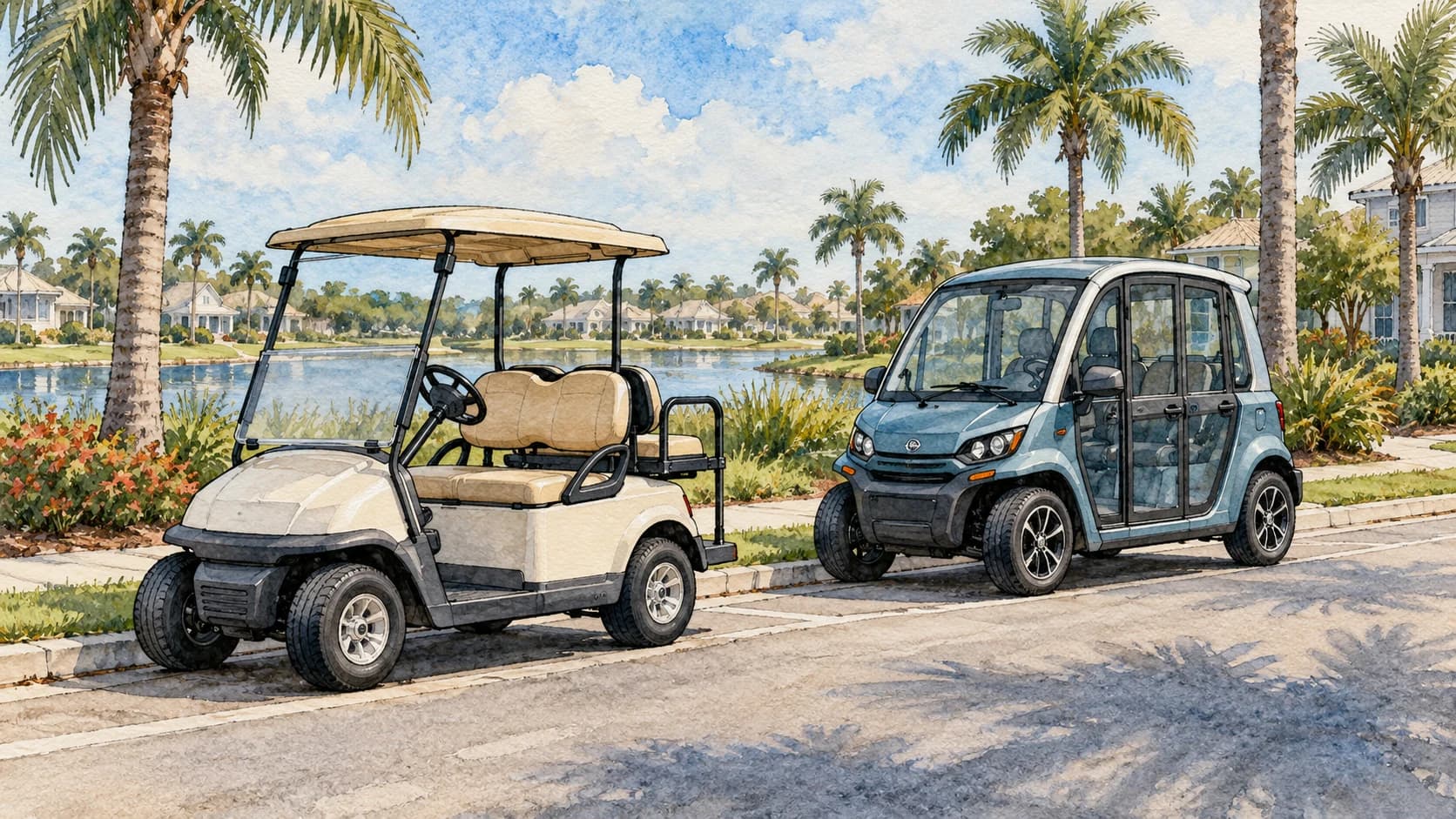
A golf cart is not automatically legal on a Port St. Lucie public street because the road is quiet or inside Tradition. Ordinary golf carts need an authorized route. A properly titled, registered and insured low-speed vehicle follows a different set of rules, including a 35-mph roadway limit and a licensed driver. Decide which vehicle you own before deciding where you can drive it.
Florida statutes, state motor-vehicle guidance and Port St. Lucie Police Department information were checked September 30, 2026. We could not verify a current citywide list of authorized ordinary golf-cart routes. The older city discussion packet described proposed permissions and does not establish that every road or path in Tradition is authorized today. For a specific journey, obtain the current designation from the city or police department before relying on it.
Related reads
Keep going without starting from scratch.
Quick list
The question this guide answers
- Private community permissions and public-road authorizations must be checked separately. We did not verify a current route list that supports blanket permission throughout Tradition. Identify your vehicle class and obtain confirmation for the exact roads and paths you intend to use.
A golf cart and an LSV are different vehicles
Florida Highway Safety and Motor Vehicles guidance distinguishes a golf cart, designed for recreational use and unable to exceed 20 mph, from a low-speed vehicle capable of more than 20 mph but no more than 25 mph. Lights added to a cart do not by themselves make it a registered LSV. Its classification and paperwork matter as much as its appearance.
When shopping, ask the seller for the manufacturer documentation, VIN and title status. A listing that says “street legal” is a sales claim until you verify the vehicle and intended route. Request the complete cost of purchase, conversion if applicable, inspection, insurance, registration and charging equipment. If the vehicle already has a Florida title, confirm that the title describes the correct vehicle and that it can be transferred before paying.
Ordinary golf carts need designated public routes
Florida Statute 316.212 generally prohibits golf carts on public roads except for its specified authorizations. Local designation and posted signs are central requirements. A neighborhood's low speed limit, another resident's behavior or proximity to a golf course does not establish permission. A shopping destination may be nearby while the connecting road remains unsuitable or unauthorized.
Start with an exact route: your driveway, each road segment, crossings and the destination's parking area. Ask Port St. Lucie Police or the responsible road authority whether that route is designated for ordinary golf carts and whether any connecting segment belongs to the county or state. A single unauthorized section can make the proposed journey impractical. Keep the answer or current official map with your vehicle records; an unrelated subdivision's rules are not a substitute.
Local tip
Use the article for evergreen ideas and the newsletter for what is happening right now.
That combination gives you the best shot at finding something that fits the season, your schedule, and what is actually open or active this week.
Private paths and older proposals do not establish street access
The city's June 2019 golf-cart discussion item discussed possible permissions in Sandpiper, St. Lucie West and Tradition. Its recommendation was to direct staff to propose an ordinance. The page's “Passed” status describes that discussion action; it should not be read as proof that every attached draft became current law or that all proposed routes were authorized.
A private community can also control its own roads, paths and amenities. Ask the community association which facilities permit your vehicle, who owns each connecting segment and whether guests may use it. A paved sidewalk or wide multi-use path is not automatically a cart route. Florida provides a process for local sidewalk authorizations, but physical width alone does not create permission. Pedestrians, bicycle users and parked vehicles can also make a legally available route a poor practical choice.
Driver identification and operating hours
Under the current golf-cart statute, a public-road operator younger than 18 must possess a valid learner's driver license or driver license. An operator aged 18 or older must have valid government-issued photographic identification. Older summaries allowing a child to drive solely because they reached age 14 are not a reliable statement of current law. A learner's license also carries its own restrictions; possessing one does not remove them.
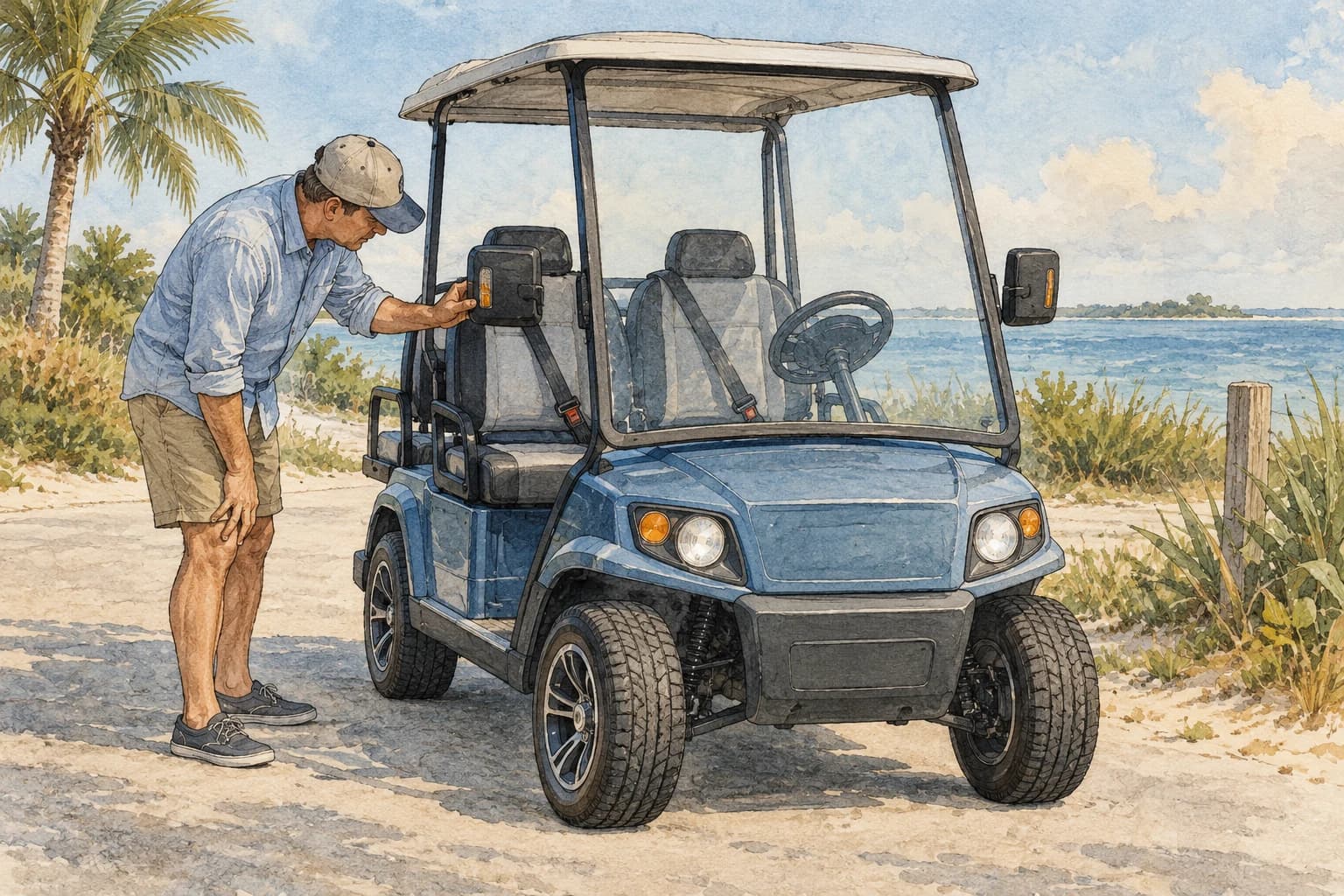
Ordinary golf-cart operation is generally limited to sunrise through sunset unless the responsible government authorizes nighttime operation and the cart has the specified lighting and windshield. Required daytime equipment includes brakes, reliable steering, safe tires, a rearview mirror and front and rear red reflectors. Check the vehicle before departure and ask about any additional local conditions. Bringing a flashlight or adding decorative lighting does not resolve a missing nighttime authorization.
A registered LSV has separate road and equipment rules
Florida Statute 316.2122 limits LSV operation to roads posted at 35 mph or less, with a provision for crossing a higher-speed road at an intersection. Required equipment includes lights, reflectors, a parking brake, mirrors, a windshield, seat belts and a VIN. The vehicle must be registered and insured, and its operator must have a valid driver's license. Local governments or the state transportation department can restrict operation where safety requires it.
The PSL police LSV flyer reinforces the title, registration, insurance and licensed-driver requirements. Before buying, inspect every road on the intended route, including short links and crossings. A compliant vehicle can still be inappropriate for a congested road or a destination with no suitable parking. Use the seat belts provided and remain within seating capacity rather than improvising a place for an additional rider.
Conversion, storage and charging costs
State guidance describes an inspection and titling process for converting a golf cart to an LSV. A conversion is more involved than installing a light kit, and an unregistered cart should be transported to the inspection rather than driven there as though the process were complete. Ask the inspecting agency what documentation and transport arrangements it requires before scheduling. Insurance coverage for a recreational cart may also differ from the required LSV policy.
At home, establish an approved storage and charging location with the community association and follow the manufacturer's instructions. Ask an electrician about the appropriate circuit if the existing outlet or wiring is unsuitable. Include battery replacement, tire maintenance and insurance in the yearly budget. For a short errand you can already walk or complete through local transit, ownership may provide less practical benefit than expected. Test the lawful route first, then decide whether the purchase solves a real transportation need.
FAQ
Common questions
Can you drive a golf cart in Tradition?
Private community permissions and public-road authorizations must be checked separately. We did not verify a current route list that supports blanket permission throughout Tradition. Identify your vehicle class and obtain confirmation for the exact roads and paths you intend to use.
Does adding lights make a golf cart street legal?
No. Lights alone do not establish an authorized golf-cart route or complete an LSV conversion. LSV operation requires the applicable equipment, inspection and paperwork, title, registration, insurance and a licensed driver.
Can an LSV use a road posted at 45 mph?
It cannot travel along that road under the ordinary 35-mph rule. Florida law provides for crossing a higher-speed road at an intersection, subject to applicable restrictions. Check the complete route rather than treating permission to cross as permission to drive along it.
Sources
Reference links
Written by
Derek Brumby
We publish Treasure Coast guides for residents, newcomers, and weekend planners. Our goal is to combine local context, linked source material, and ongoing page updates so a reader can act on the guide instead of just skim it.
Derek Brumby is the sole author and editor. On The Treasure Coast is owned and published by Brumby LLC.
Research and updates
Last verified September 30, 2026
This guide was written and edited by Derek Brumby using linked local and official sources, then reviewed for Treasure Coast planning context.