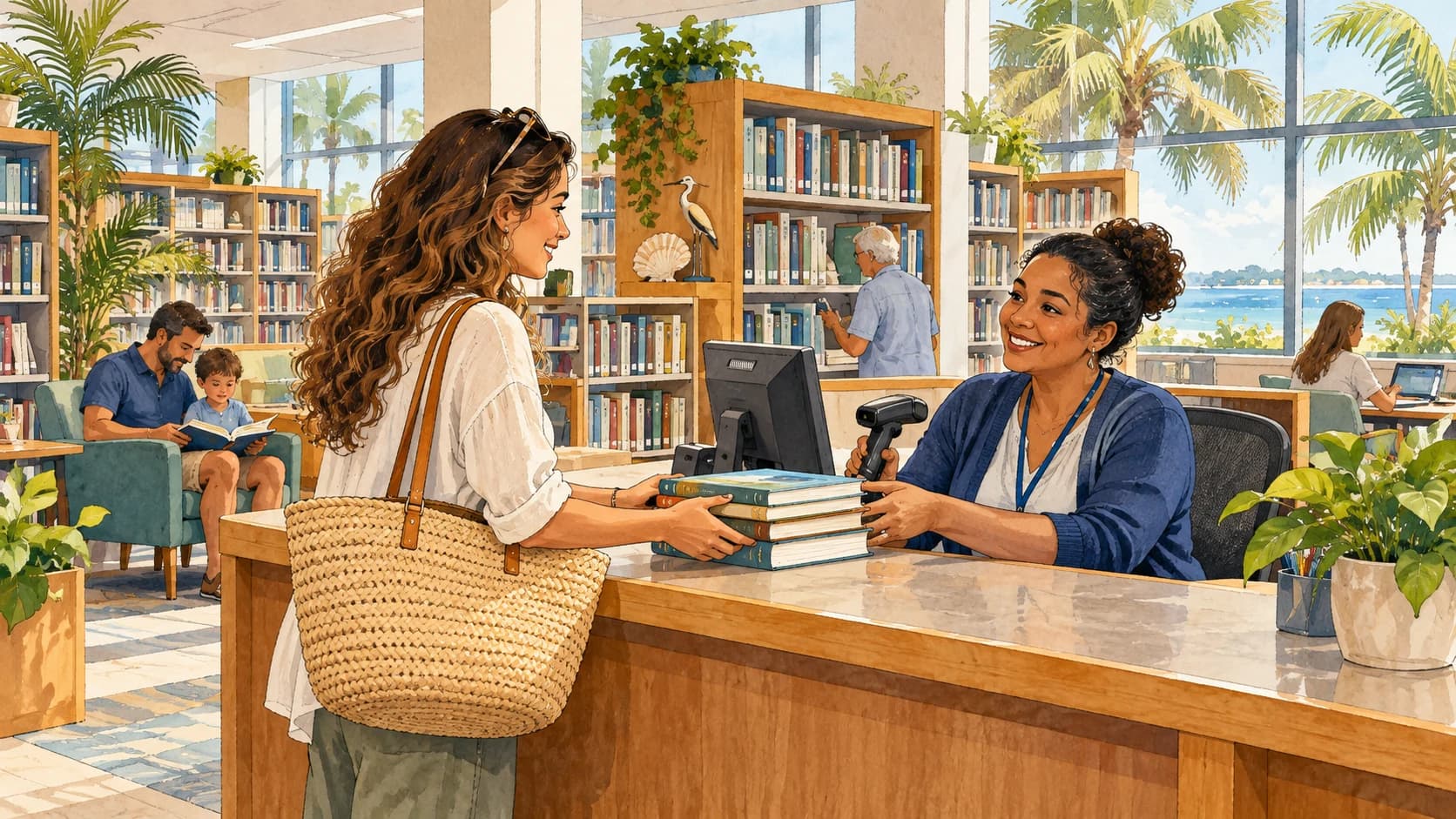
St. Lucie County residents can get a free library card by applying at an open branch with photo identification, proof of county residence, and a phone number or email address. Applicants sixteen or older can also begin by phone or online with a temporary card, then complete the in-person requirements for physical borrowing. You do not have to own a home to apply.
Bring the documents that show your current address, particularly if you recently moved and your driver's license still shows another county. The county's card policy explains acceptable alternatives and free-card exceptions. A card can provide digital reading and streaming as well as books, but the temporary-card and full-use-card rules differ.
Related reads
Keep going without starting from scratch.
Quick list
The question this guide answers
- Visit an open branch with photo ID, proof of county residence, and contact information, then complete the application. Eligible residents receive a free card. Applicants sixteen or older can begin with a temporary card by phone or online.
Apply at a branch with the right documents
Complete and sign the application at the library, present your photo ID and address evidence, and provide contact information. If your ID lacks a current St. Lucie address, the policy accepts alternatives such as a recent utility bill, qualifying rental agreement, or other listed evidence. Check the complete document list before visiting if you are using an unusual form of identification. The library can decide whether a particular document meets its policy.
Put your ID and address document together before leaving home. For a recent move, compare the address on the application with the address on the evidence you are bringing. If the two differ, call the branch and describe the situation before making a special trip. Library staff need to verify eligibility; a photograph of a house or a map pin showing where you live is not a useful substitute for the requested documents.
Start online when you want digital access first
The county offers a thirty-day temporary card for applicants sixteen or older who begin by phone or its online form. It allows access to online resources and up to five holds on physical items, but not physical checkout. To make it a full-use card, visit a branch and complete verification. Use the card policy's application link so you begin in the official county system.
Keep the account number and instructions somewhere you can retrieve them when signing into a reading app. Set aside time to visit the branch before the temporary period ends, rather than waiting until a held item is ready. If you are applying mainly for an ebook during an evening or weekend, first check whether your card has been issued and whether the resource accepts it. Submitting a form is different from having an active account number.
Local tip
Use the article for evergreen ideas and the newsletter for what is happening right now.
That combination gives you the best shot at finding something that fits the season, your schedule, and what is actually open or active this week.
Children's cards and adult responsibility
For a child fifteen or younger, the county's application form requires a responsible adult to complete and sign the relevant portion. The form asks for the adult's relationship to the child, address, identification, and signature. It also explains responsibility for borrowed materials and applicable charges. Bring the adult's documents and plan for that adult to participate in the application rather than sending the child alone.
Use this visit to decide how your family will keep track of books and due dates. A child can choose books independently while an adult helps monitor the account. Store the card number where the responsible adult can find it, and report a lost card promptly. If responsibility for an existing child's account needs to change, ask the library about its process instead of opening another card and assuming the earlier account has disappeared.
Nonresidents and free-card exceptions
The published policy offers a $25 annual nonresident card and also identifies people who may qualify for a free card through a county connection, such as students enrolled locally or specified public employees. County business owners are addressed in the free-card rules as well. Ask about the exception that applies to you and bring the required evidence. A Port St. Lucie mailing address or nearby workplace should be checked against the actual county and eligibility rules.
For a paid nonresident application, follow the county's current instructions, including any available mail process. Ask about account renewal before using a card for a long-term digital subscription routine. This guide does not expand eligibility to everyone on the Treasure Coast: Martin and Indian River residents who lack a qualifying St. Lucie connection should check the nonresident rules or their own county library system. Keep annual charges separate from any charges connected to lost or damaged materials.
Pick an open location
Morningside Branch is at 2410 SE Morningside Boulevard. Its current page lists Tuesday and Thursday evening hours, with other openings through Saturday. That can be useful when you need to complete an application after work. Check the day's hours and holiday notice before leaving, especially if the card visit is part of another errand.
Pruitt Campus Library, at 500 NW California Boulevard, is open to the public through a county and Indian River State College partnership. Its schedule follows the college and may change during breaks. The county's September 2026 newsletter says the Ravenswood library remains under construction and identifies Library-to-Go and holds pickup at the Port St. Lucie Community Center. Use an open staffed branch for document verification; a vending machine is a different service.
Put the card to use digitally
For ebooks, the county's Libby instructions tell you to select St. Lucie County Library System and sign in with your card number. Search for a title and choose Borrow or Place Hold according to availability. Compatible ebooks can also be sent to a Kindle through the app's process. Digital loans return automatically at their due date, though an early return can release a title sooner.
The digital-media page also describes CloudLibrary, hoopla, and Kanopy. It currently lists six hoopla borrows per month and explains that a library-wide daily spending cap can temporarily pause new checkouts. That message is not necessarily a problem with your individual card. Use the county's help links or ask library staff if you cannot sign in, and check the current limits before assuming a streaming service provides unlimited use.
Benefits beyond downloading a book
The September 2026 library newsletter highlights Brainfuse tutoring, homework help, career resources, and test preparation as well as digital books and films. Choose the service from the library's own resource page so you reach the version included with the county account. A general commercial sign-up page may ask you to buy access that the library provides through a separate login.
Branch services can differ. Morningside lists a Digital Studio for converting family media, public computers, printing, and ukuleles for checkout. Ask about booking, training, or borrowing requirements for a particular item rather than expecting every service at every location. At your card appointment, tell staff what you want to use first. That is often the quickest way to learn the right catalog, app, or reservation process for the service that brought you in.
FAQ
Common questions
How do I get a St. Lucie County library card?
Visit an open branch with photo ID, proof of county residence, and contact information, then complete the application. Eligible residents receive a free card. Applicants sixteen or older can begin with a temporary card by phone or online.
Can I check out physical books with a temporary card?
The thirty-day temporary card provides online access and up to five physical-item holds, but not physical checkout. Complete the branch verification process for full use.
Can someone from another county get a card?
The county offers a $25 annual nonresident card and certain free-card exceptions for qualifying local connections. Check the policy and required evidence before applying.
Sources
Reference links
Written by
Derek Brumby
We publish Treasure Coast guides for residents, newcomers, and weekend planners. Our goal is to combine local context, linked source material, and ongoing page updates so a reader can act on the guide instead of just skim it.
Derek Brumby is the sole author and editor. On The Treasure Coast is owned and published by Brumby LLC.
Research and updates
Last verified September 30, 2026
This guide was written and edited by Derek Brumby using linked local and official sources, then reviewed for Treasure Coast planning context.