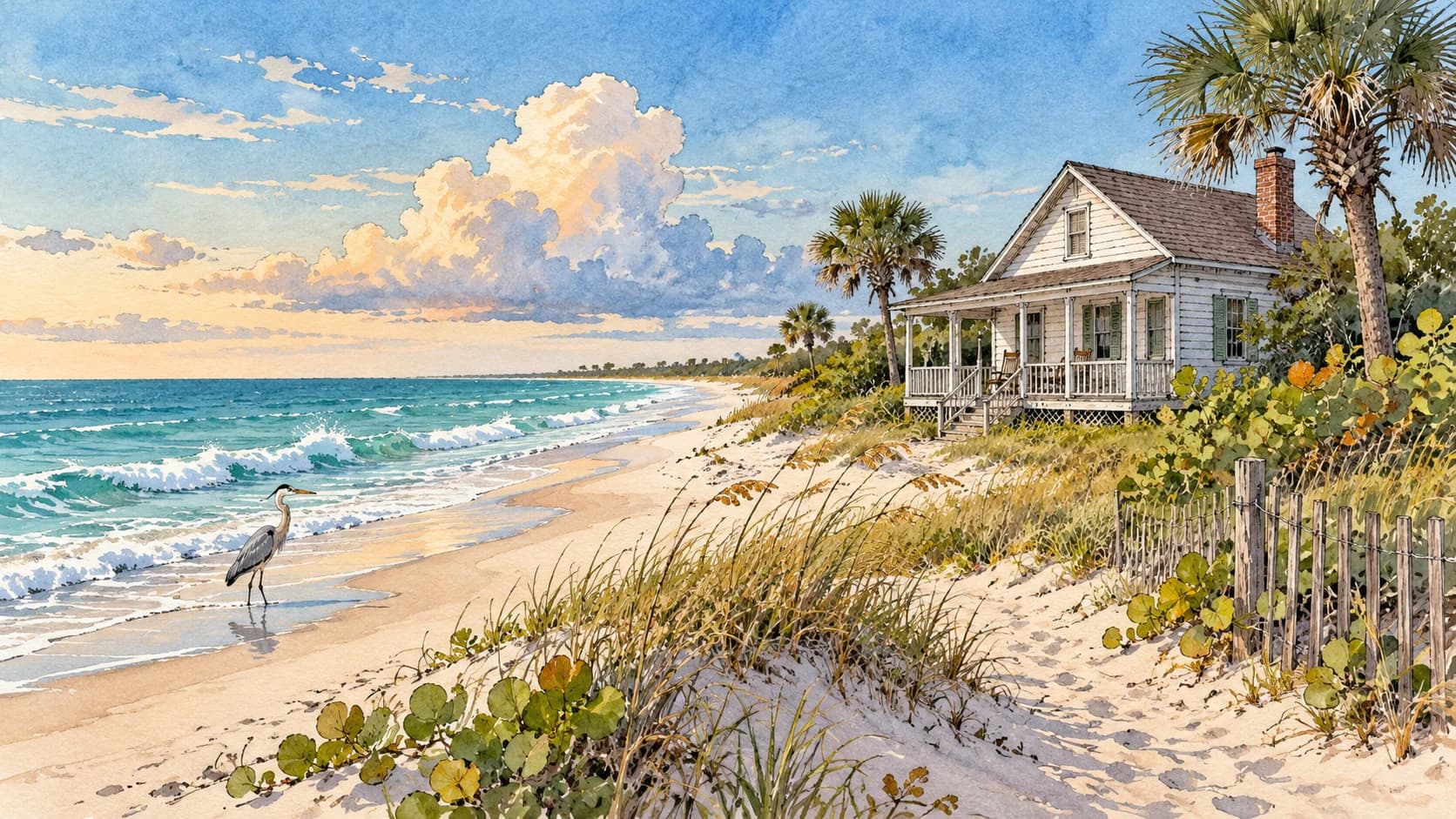
The House of Refuge at Gilbert's Bar was a shelter for shipwreck survivors on a sparsely settled Florida coast. Built in 1876, it is the last surviving Florida house of refuge and the oldest building in Martin County. Today it is a museum at 301 SE MacArthur Boulevard on Hutchinson Island in Stuart. Its small scale is part of the story: people who reached this coast needed immediate shelter and help, not a grand maritime terminal.
Confirm tour access before driving. On September 30, 2026, the site's main page described visitors returning after restoration, while the operator's general tours page still contained a renovation-closure notice. Because those official pages conflict, call the House of Refuge at 772-225-1875 about your date, the available route, and any scheduled tour. Do not let a published hours footer alone settle that question.
Related reads
Keep going without starting from scratch.
Quick list
The question this guide answers
- It is an 1876 shelter built for shipwreck survivors, now a museum interpreting coastal lifesaving and local maritime history. It is the last surviving Florida house of refuge.
What a house of refuge was for
The museum's history describes houses maintained under the U.S. Life-Saving Service to help sailors stranded after wrecks. Keepers lived on site with their families and searched the coast after storms. The building's purpose was practical: shelter, provisions, and assistance along a coast where a survivor could not assume a nearby town or a reliable road out.
That purpose gives the visit a clear focus. Look at the relationship between the house, shore, and living space instead of expecting a large collection of ships. Ask how a keeper's family balanced normal daily life with emergency work. The site is also a useful place to distinguish the history of a refuge house from a lighthouse, a fort, or a modern lifeguard station. They answered different problems.
A surviving building on a changing coast
Martin County's historic-preservation list identifies the House of Refuge as an 1876 public historic site. Its preservation has involved more than repainting a visible exterior. The county's capital plan describes engineering, foundations, drainage, weatherproofing, and accessibility work informed by a historic-structures study.
Those repairs are relevant to visitors because the coast keeps acting on the building. A closure can be necessary even when the grounds look attractive in a photograph. Respect barriers and staff directions, and ask which parts of the restoration are being interpreted during the visit. An older review may describe rooms, stairs, or exhibits that are no longer part of the same route.
Local tip
Use the article for evergreen ideas and the newsletter for what is happening right now.
That combination gives you the best shot at finding something that fits the season, your schedule, and what is actually open or active this week.
What the restored museum describes
The museum's main page now describes The Tempest, a lower-level installation using sound and a mural to interpret dangerous coastal storms. It also identifies new history displays and the Boathouse Gift Shop. These give you a reason to visit the interior if it is available on your date. Contact staff if sound, stairs, or lower-level access could affect someone in the group.
Avoid building an itinerary entirely around a single room. A docent's explanation of the site and a close look at the keeper's living environment can be the more useful part of the visit. For children, one question is enough: what would a person need after surviving a wreck? Let the exhibits supply the answer. Adults interested in preservation can ask what had to be repaired and what original material remains.
Admission and the Elliott combination
The Historical Society's ticketing page listed House of Refuge adult admission at $12, seniors sixty-five and older at $10, and youth ages six through twelve at $8 at the research date. Children five and younger and qualifying U.S. veterans and active military personnel were complimentary under the listed policy. Confirm current eligibility, availability, and tour arrangements before purchasing.
The same operator sells an Elliott Museum combination ticket. The two places share an operator but are separate stops with different schedules. Make the combination choice only after confirming the House of Refuge visit. You should also ask how long the ticket remains valid; the ability to buy a combination does not by itself mean both visits must or can happen that afternoon. Leave travel and meal time between the two.
The shoreline and the Georges Valentine wreck
The museum interprets the Georges Valentine wreck off the nearby coast. Its presence helps explain the hazards that made refuge houses necessary. It does not make a museum outing an automatically suitable snorkeling trip. An offshore wreck involves water entry, visibility, sea conditions, boat traffic, and the ability to return to shore. Stay with the historical visit unless a separate water plan has been assessed appropriately.
For a normal visit, view the coast from the access permitted by staff and current signs. Do not climb around a barrier for a photograph or assume that an old map shows today's safe route. The value of the shoreline is already visible in the museum's story: a rocky, exposed coast that could be difficult for people arriving from a damaged vessel. You can understand that setting while remaining on land.
How much time to allow
For planning, reserve roughly an hour to ninety minutes for the museum, grounds, and questions, then adjust once staff confirms the visit format. That is an editorial estimate, not a published tour duration. A scheduled program may require longer, and limited access may shorten the ordinary visit. Arriving just before closing leaves little room for a docent conversation.
The ticketing page's standard hours list Monday through Saturday, 10 a.m. to 4 p.m., and Sunday, 1 p.m. to 4 p.m., with holiday closures. The access conflict described above makes direct confirmation necessary. Ask where to park, how the arrival works, and whether anyone's mobility or sensory needs affect the available route. For a broader family comparison, see the Treasure Coast museum guide, then choose the House of Refuge for the coastal history that interests your group.
FAQ
Common questions
What is the House of Refuge in Stuart, Florida?
It is an 1876 shelter built for shipwreck survivors, now a museum interpreting coastal lifesaving and local maritime history. It is the last surviving Florida house of refuge.
Is the House of Refuge open after renovation?
The main museum page describes renewed visiting after restoration, but the general tours page still carries a closure notice. Confirm access for your date directly with the museum before traveling or buying a ticket.
Is a visit the same as a trip to the shipwreck?
No. The museum explains the nearby Georges Valentine wreck. Going into the ocean to see it is a separate activity requiring suitable ability, equipment, conditions, and access arrangements.
Sources
Reference links
- Historical Society of Martin County: House of Refuge history and restoration notices
- Historical Society of Martin County: tour information and conflicting closure notice
- Historical Society of Martin County: current ticketing
- Martin County: historic-preservation site list
- Martin County: FY26 restoration and rehabilitation project
Written by
Derek Brumby
We publish Treasure Coast guides for residents, newcomers, and weekend planners. Our goal is to combine local context, linked source material, and ongoing page updates so a reader can act on the guide instead of just skim it.
Derek Brumby is the sole author and editor. On The Treasure Coast is owned and published by Brumby LLC.
Research and updates
Last verified September 30, 2026
This guide was written and edited by Derek Brumby using linked local and official sources, then reviewed for Treasure Coast planning context.