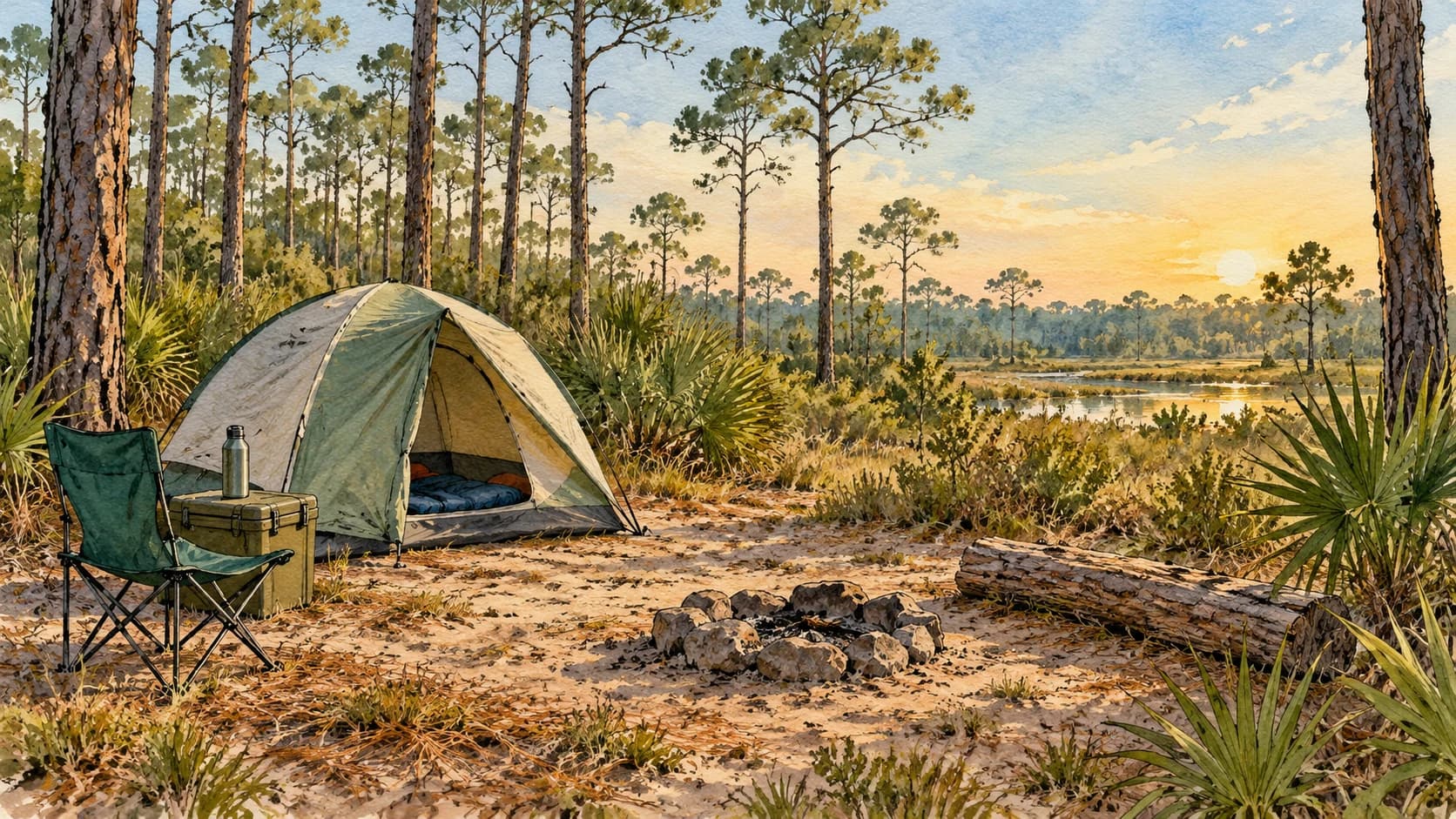
You can legally camp for free at designated, authorized campsites on some Florida water-management lands. Near the Treasure Coast, start with South Florida Water Management District camping at DuPuis Management Area and Allapattah Flats. Get the required Special Use License, check the campground and dates, and use the approved site. Public ownership, a parking lot or a trailhead does not by itself authorize overnight camping.
The useful question is whether a specific campsite fits your tent, vehicle, dates and preparation. Free primitive camping can involve carrying supplies, limited facilities and seasonal closures. This guide separates two realistic regional leads from statewide options and paid campgrounds. Rules were checked September 30, 2026; the permit and current property notices should guide the final booking decision.
Related reads
Keep going without starting from scratch.
Quick list
The question this guide answers
- Designated campsites on some SFWMD and St. Johns River Water Management District lands offer no-cost camping with the required authorization. Some Suwannee River camps also have no charge. Check the specific manager, site and access rules.
Start with the land manager and the permit
The South Florida Water Management District Special Use License page describes a no-cost license for activities including camping. Its reservation system lists the available properties and camping categories. Select the actual campground rather than assuming every part of a management area permits camping. Read the conditions attached to the license, confirm the dates and occupants, and retain the access instructions before departure. A submitted request is not a substitute for the issued authorization.
Check the notices again shortly before leaving. The district warns that some campgrounds and interior roads can close temporarily. A calendar showing a campsite does not prove a particular vehicle can use every entrance or road. If your vehicle type, pets or access needs are not addressed clearly, ask the district before making the drive. Its recreation hotline is 866-433-6312. Keep any gate information private and follow the license instructions for entering and leaving the property.
DuPuis: choose the right camping area
DuPuis Management Area lies off State Road 76 between State Road 710 and U.S. 441, west of the coastal towns. The district identifies Gate 1 for family camping, Gate 2 for the hiking trailhead and Gate 3 for equestrian and trailer camping. The property has separate equestrian and non-equestrian camping areas; the equestrian portion requires at least one horse per Special Use License. Choose the category that actually matches your party.
Do not interpret “trailer camping” as permission to arrive at any DuPuis campsite with any RV. Confirm the campground’s current vehicle and equipment rules in the reservation record. The district currently permits up to two dogs per license within the campground, while other pet rules apply elsewhere on the property. Ask where the dog may accompany you before planning a trail outing. DuPuis offers a quiet inland setting rather than an oceanfront beach campsite, so build the trip around the landscape instead of expecting beach access outside the tent.
Local tip
Use the article for evergreen ideas and the newsletter for what is happening right now.
That combination gives you the best shot at finding something that fits the season, your schedule, and what is actually open or active this week.
Allapattah Flats: a designated site, not dispersed camping
The district lists tent camping at Allapattah Flats, west of Stuart. FWC’s visitor information specifies camping in the designated campsite with a Special Use License. That distinction matters: finding a flat patch along a trail does not make it a permitted overnight site. Use the reservation details and property map to identify the campsite, entrance and approved access.
This is also a wildlife-management area with hunting activities. Read the current FWC area brochure and district notices for your dates rather than relying on an old trip report or a general “hunting season” description. Ask how the scheduled activity affects camping and trails. Bring enough water and supplies for the facilities actually listed for your campsite. For a first primitive overnight, keep the arrival plan simple and allow daylight to locate the entrance and establish camp without assuming cell service will resolve every uncertainty.
Other free Florida camping has different rules
The St. Johns River Water Management District camping page provides another statewide option. Its designated campsites are free, but dispersed camping is prohibited and camping is tent-only: RVs, trailers, truck campers and van campers are excluded. Drive-in and hike-in sites require reservations; certain boat-access sites use different arrangements. The current reservation window is up to 90 days ahead, with reservations required at least 48 hours in advance, before 1 p.m. two days before arrival.
Those rules replace older district articles suggesting shorter notice or broader first-come access. Use the current campsite listing, not the age of a search result, to plan the stay. A different statewide example is Woods Ferry River Camp on the Suwannee River. The park describes no-charge river-camp stays, but access is by river or certain hiking routes, with no vehicles. It is an option for a properly planned North Florida paddling trip, not a nearby place to park a Treasure Coast RV.
Primitive camping and free parking are separate things
Florida State Parks primitive camping generally carries a per-person fee. “Primitive” describes the camping arrangements and limited facilities; it does not mean free. County campgrounds and private RV parks also have their own charges and reservations. If you need electric hookups, a dependable shower or a site suitable for a large motorhome, use the RV campground guide and compare the required facilities directly.
A day-use park, beach parking space or roadside turnout is not an alternative campsite unless its manager explicitly permits overnight use. Fort Pierce’s parking information includes restrictions on overnight parking in parks. Follow the rules for the exact property even when the parking itself costs nothing. Likewise, a business allowing a vehicle to park does not grant access to nearby public land for camping. Get explicit authorization for the place where you intend to spend the night.
Make the no-cost site work for the whole party
Before booking, match the site against five practical needs: access, sleeping equipment, water, toilets and the ability to leave if conditions change. Confirm whether supplies stay beside the vehicle or must be carried in. Bring a suitable tent, drinking water, food storage, insect protection and a way to remove all waste. Check the manager’s fire rules and local burn restrictions; an existing fire ring does not overrule a ban. Plan for rain and wet ground rather than assuming a free site includes a covered shelter.
Compare the whole trip with a modest paid campsite. Extra driving, equipment purchases or a boat transfer may outweigh the avoided camping fee. If a family member needs a facility the site does not provide, choose a campground that does. Free camping is most useful when its limitations fit your group, not when it becomes an exercise in improvising missing essentials. For a local first trip, DuPuis or Allapattah is worth checking, but leave without a reservation only when the manager’s current instructions explicitly permit that arrangement.
FAQ
Common questions
Where can you legally camp for free in Florida?
Designated campsites on some SFWMD and St. Johns River Water Management District lands offer no-cost camping with the required authorization. Some Suwannee River camps also have no charge. Check the specific manager, site and access rules.
Is there free RV camping near Port St. Lucie?
DuPuis lists RV/trailer camping categories, but the permitted equipment depends on the campground and license. Verify your vehicle and site before traveling. Allapattah tent camping and St. Johns district tent sites should not be treated as interchangeable RV options.
Can I camp anywhere on public land?
No. These managers designate where camping is allowed and may require reservations, licenses or particular access methods. Public trails, beaches and parking lots do not automatically permit an overnight stay.
Sources
Reference links
- SFWMD: no-cost Special Use Licenses and reservations
- SFWMD: DuPuis camping areas and access
- SFWMD: Allapattah Flats
- FWC: Allapattah camping and wildlife-management rules
- SJRWMD: current camping and reservation rules
- Florida State Parks: Woods Ferry River Camp
- Florida State Parks: primitive camping
- City of Fort Pierce: parking restrictions
Written by
Derek Brumby
We publish Treasure Coast guides for residents, newcomers, and weekend planners. Our goal is to combine local context, linked source material, and ongoing page updates so a reader can act on the guide instead of just skim it.
Derek Brumby is the sole author and editor. On The Treasure Coast is owned and published by Brumby LLC.
Research and updates
Last verified September 30, 2026
This guide was written and edited by Derek Brumby using linked local and official sources, then reviewed for Treasure Coast planning context.